
If AI does the thinking and doing, what's left for you?

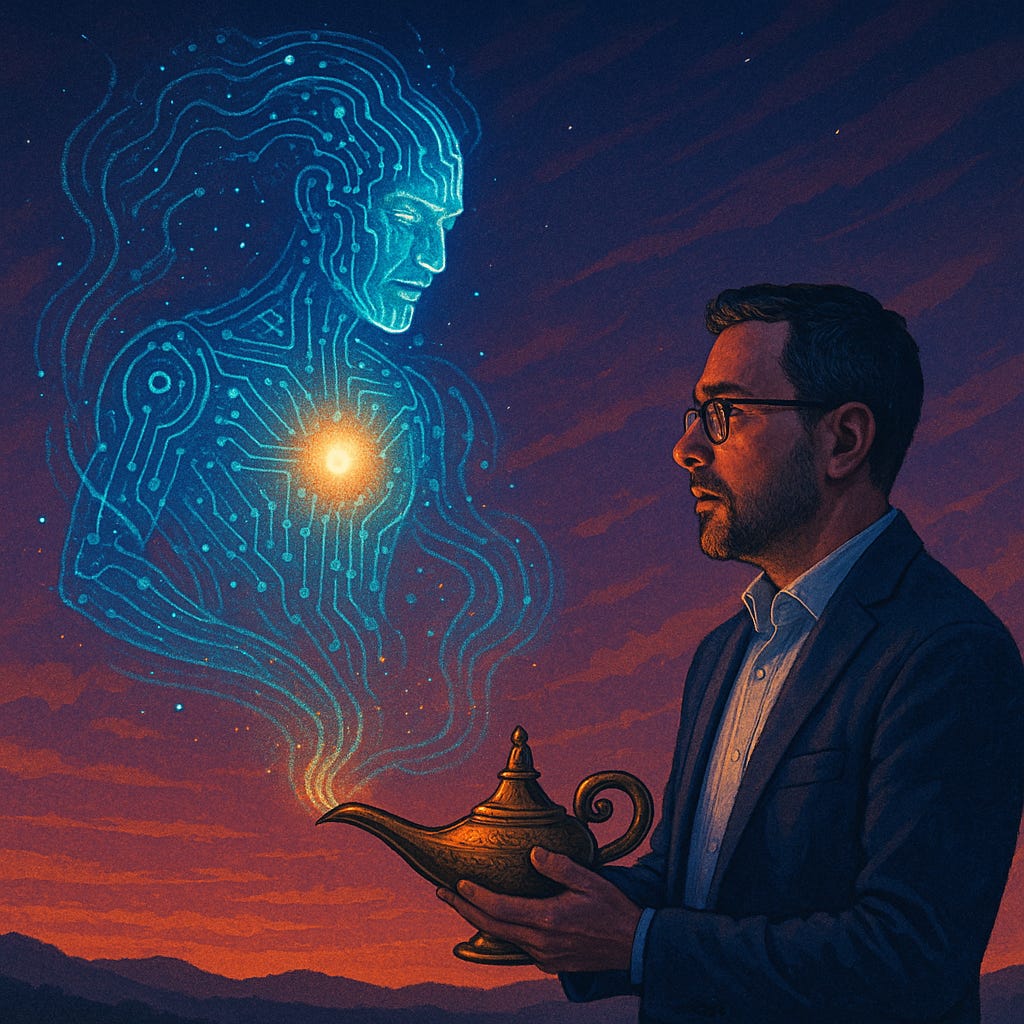
Recently, I had one of those “insights while taking a shower” moments. It shaped how I think about professional adaptability in the age of AI.
Everyone’s talking about how many jobs will disappear, who will be the winners and losers in the AI revolution.
Whether or not you think these scenarios are overhyped, the reality is that large language, sound, and image generation models are getting more intelligent and capable at an exponential rate.
Many experts estimate that we are 3-5 years away from achieving what’s known as AGI (Artificial General Intelligence).
While there’s a lot of debate around what constitutes AGI, let’s simply say that it’s the point when machines are capable of handling most of the cognitive tasks we rely on to earn a living.
So, the most jarring question is:
If artificial intelligence takes over a lot of the “thinking and doing” part of work (i.e., writing, calculating, researching, analyzing, synthesizing, ideating, reporting, drawing, designing, prototyping, illustrating, responding, etc), then what’s left for us?
I would place my bets on one word:
Ingenuity.
Yes, ingenuity. The kind of ingenuity that can’t be automated. The type of ingenuity that owns the outcomes and directs the AI.
Setting goals.
Making inferences.
Having epiphanies.
Bringing people together.
Questioning rules and assumptions.
Deciding when and when not to act.
Setting trends, standards, and tastes.
Deciding which problems deserve solving.
Imagining unique use cases and solutions.
Building systems of AI tools that interact with each other.
That’s our opportunity: not to compete with machines, but to collaborate with them and amplify our creative power.
I’ve started calling this mindset shift AI²:
🔹 Artificial Intelligence on the tech side
🔹 Augmented Ingenuity on the human side
They’re two sides of the same coin.
Where AI executes at scale, Ingenuity knows what matters.
Where AI is brute processing power, Ingenuity is selective focus.
Where AI can create endless options, Ingenuity chooses the one that will land.
If you’re in mid-career, this shift is critical. You don’t need to become a computer scientist or an expert in machine learning.
But you do need to become someone who knows how to direct, frame, and stretch what AI can do, because your value will increasingly lie in what the machine can’t do: imaginative, ethical, cross-disciplinary insight.
So, I’ll leave you with a simple question to ponder:
If AI handles the intelligence, how will you handle the ingenuity?